What If Etsy Was the Best Place for Gifting?
That insight shaped how we approached Gift Mode, a six-week vision project that reimagined gifting at Etsy and set in motion one of the company's biggest product launches.
My Role
I was one of two Staff Product Designers on Etsy's newly formed Future Vision Lab, a five-person team of senior ICs handpicked to work on high-velocity, forward-looking projects outside the normal product roadmap. The team included two Staff UX Researchers, a Staff Analyst, and was led by a Senior Director of Research who has since gone on to be Head of UX Research at Etsy. Our primary design stakeholder was the Head of Design; our audience was the executive team, including the CEO.
Context
Gift Mode emerged from Etsy's annual Long Term Company Strategy exercise, a cross-functional effort to identify big bets the company could pursue over a 3-5 year horizon. This was typically an executive and strategy/operations exercise; product teams didn't usually participate. But the Future Vision Lab was brought in specifically to paint a compelling picture of what Etsy could become.
Our prompt was simple: What if Etsy was the best place for gifting?
The opportunity
Gifting already accounted for roughly 25% of Etsy's Gross Merchandise Sales, but the experience wasn't optimized for it. Etsy wasn't even ranking on the first page of Google for basic gift-related searches. We flagged it early, the SEO team fixed it immediately, and it signaled a larger truth: Etsy had a lot of room to grow.
Arriving at the insight
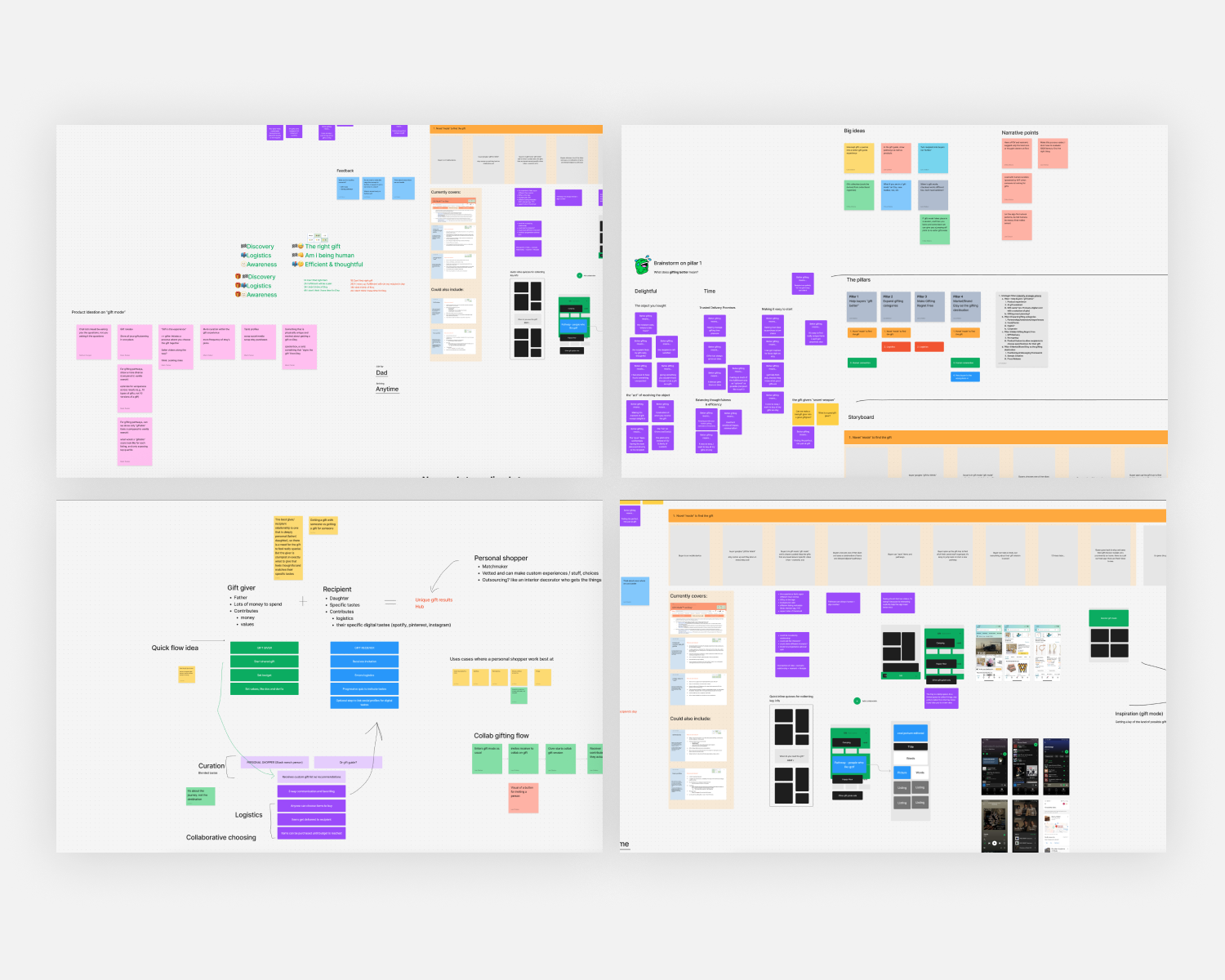
Design and research worked in parallel, not sequentially. While the researchers synthesized past studies, competitive audits, and internal data, we were already exploring concepts in Figma. The two tracks informed each other constantly.
The insight that became our foundation, buying a gift is different from buying something for yourself, sounds simple when you say it. But it took reading through a lot of past research, internal analytics on gifting behavior, and mapping the end-to-end journey together. Distillating those inputs gave us something to design around.
Pushing past safe
A few weeks in, we had a private critique with the Head of Design. The feedback was direct: we were too constrained by our own thoughts of feasibilty.
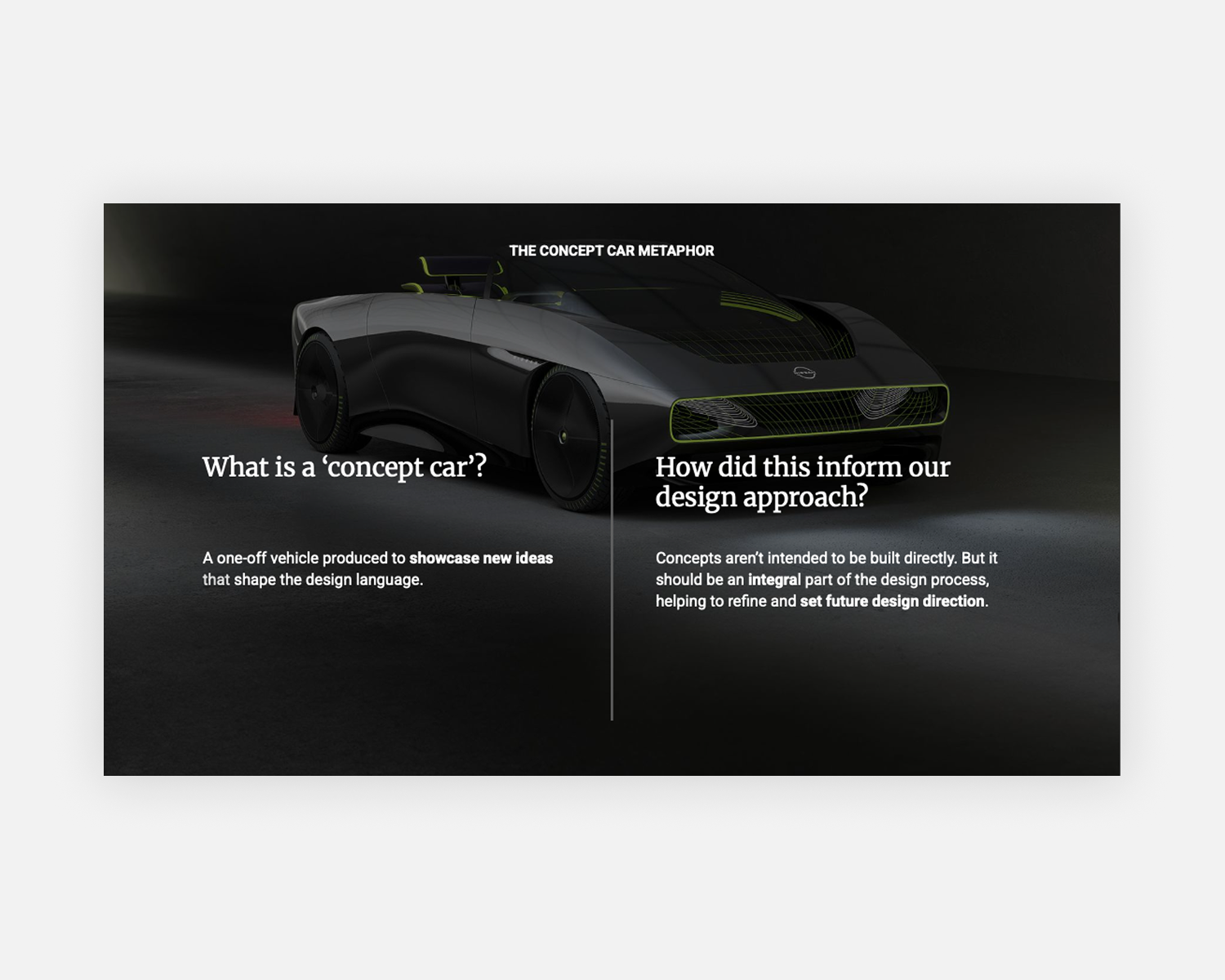
So we recalibrated. We adopted what I came to call a "concept car" philosophy: design something that isn't meant to ship as-is, but that showcases where the product could go. Concept cars aren't built for the road. They're built to excite, to provoke, to set a direction.
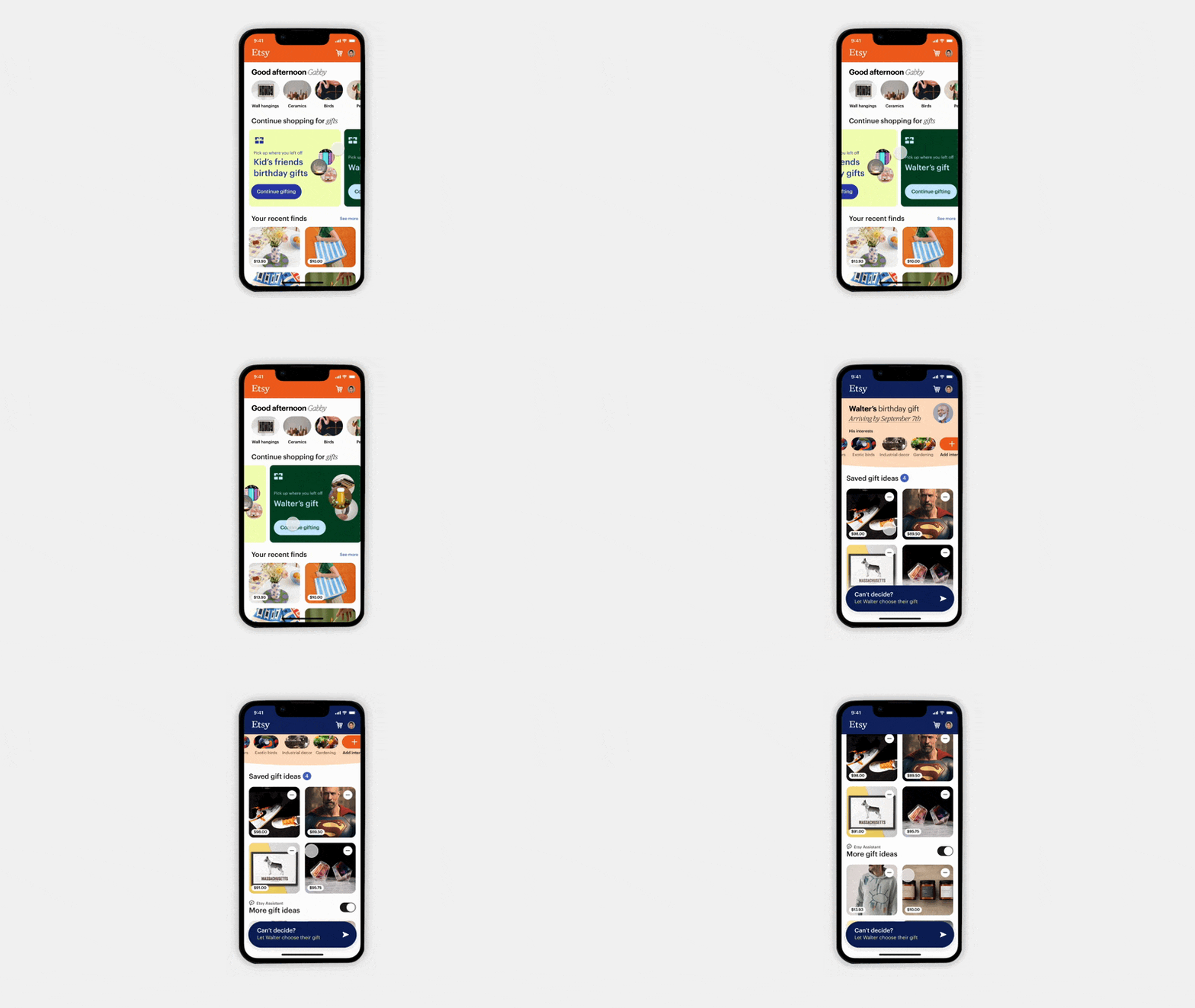
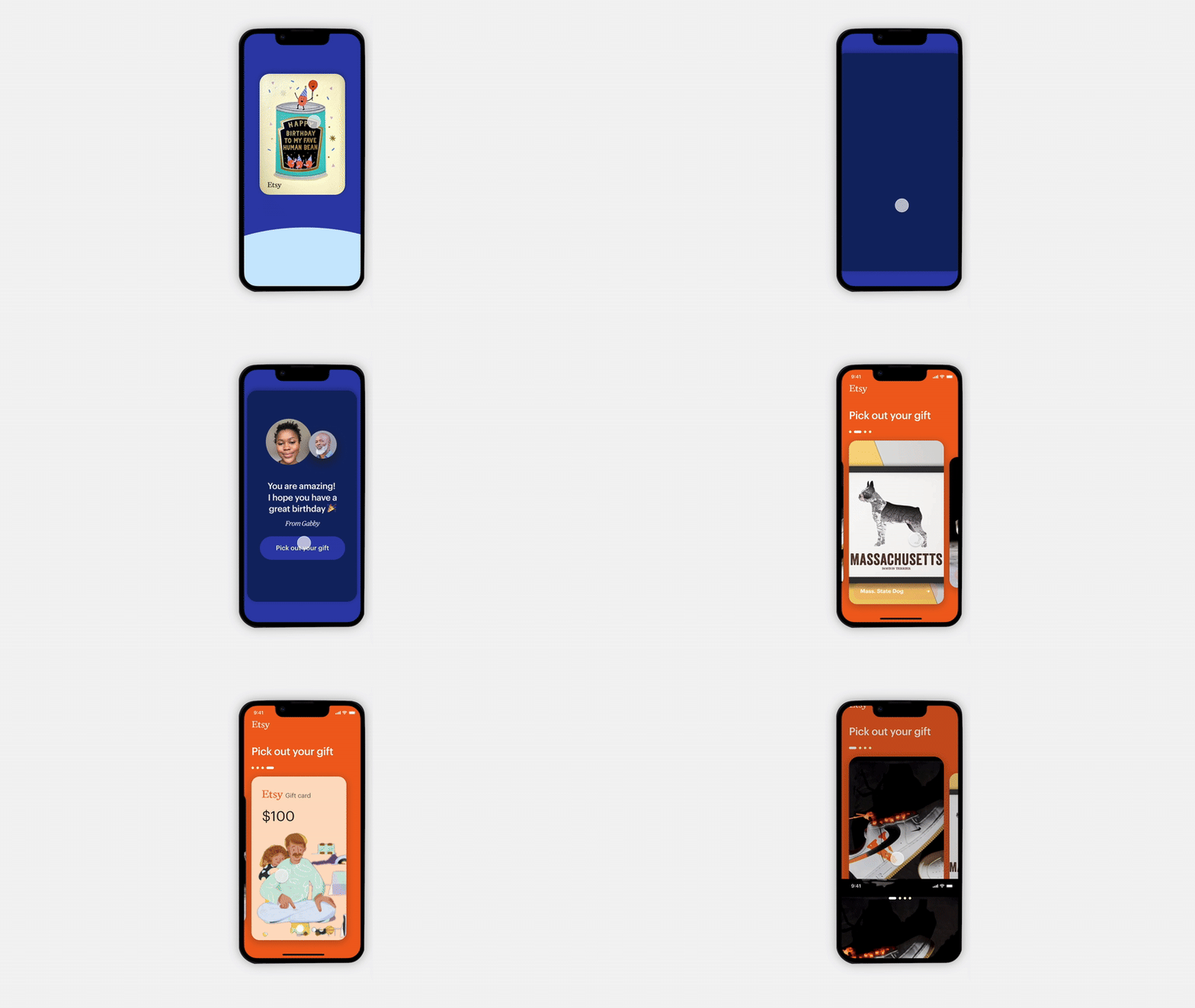
For Gift Mode, that meant pushing past Etsy's existing design system and imagining features that felt almost foreign: exploratory swipe gestures instead of endless scroll, persona-based browsing instead of keyword search, a visual language that felt distinctly different from the rest of Etsy. The goal wasn't to spec every detail. It was to show leadership what was possible. Then, once we had buy in we could break it down into something buildable.
Key design philosophy and choices
One of the core ideas I pushed was that we couldn't just rely on algorithms. Algorithms are great at scale, but without guidance they can produce results that are generic or overwhelming.
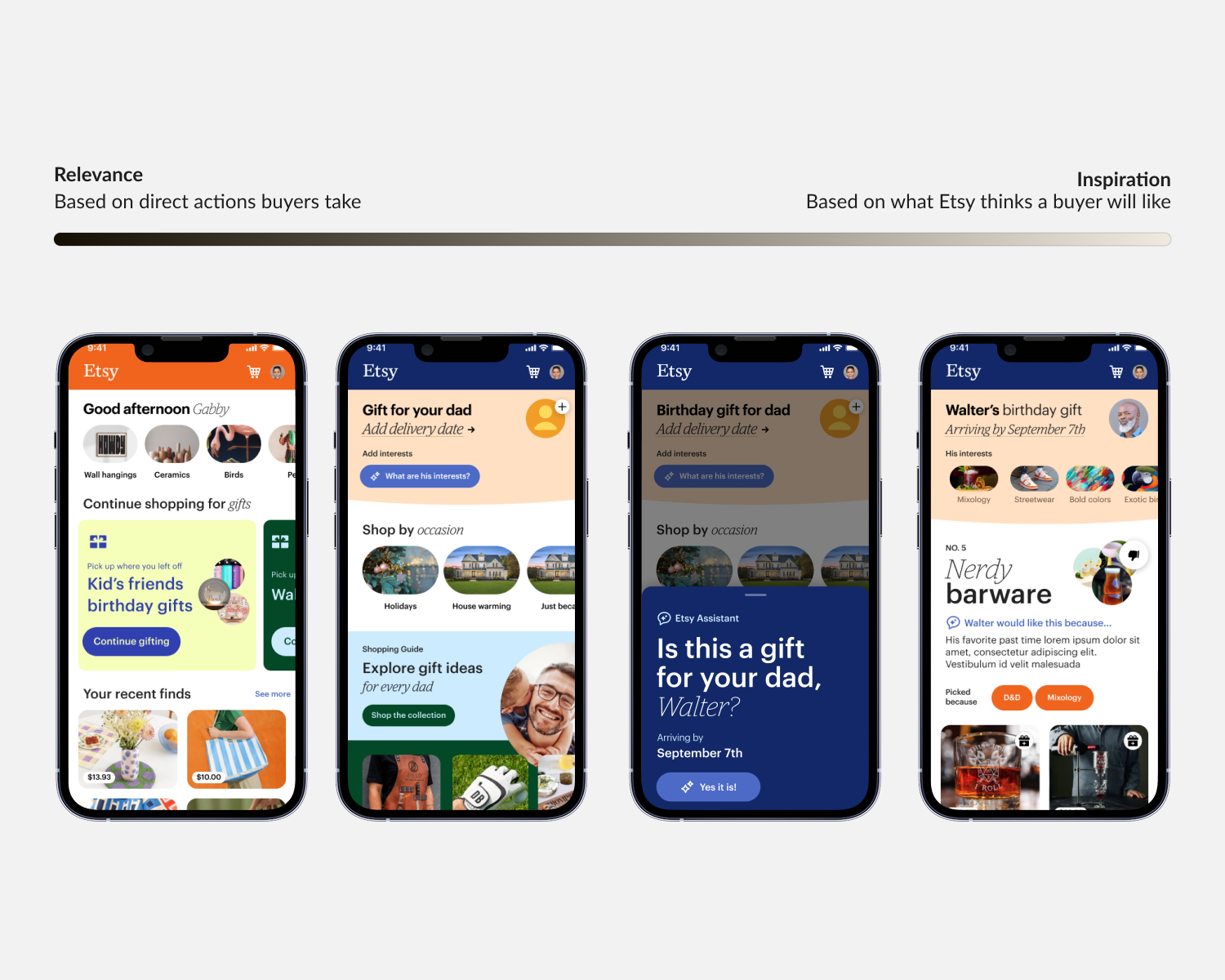
We needed a different approach: blend human editorial curation with machine learning. Humans could create compelling themes and personas ("the gamer," "the pet parent," "the chef") and seed them with handpicked items, almost like playlists. Then, algorithms could use those to surface Etsy's vast inventory in a way that felt curated.
That philosophy shaped our design choices. Gift shopping should feel broad but adaptive, not like search results, or just category based, but like Etsy is a thoughtful guide. Like it was fun to stumble through what we chose to show you as a buyer. We leaned into showing ideas (like "Rad Shoes" or "Nerdy Barware"), and not just items. We focused on showing themes that were hard for us to build with structured data and the taxonomy at the time, but that felt compelling. "Gifts for the dad who loves mixology and nerdy stuff" vs "Gifts for Dad."
Making it real
To sell the vision, we produced a narrative video that walked through the entire gifting experience, from realizing you need a gift through discovery, selection, and sending. The researchers narrated it, and I contributed heavily to prototyping, video production, and motion.
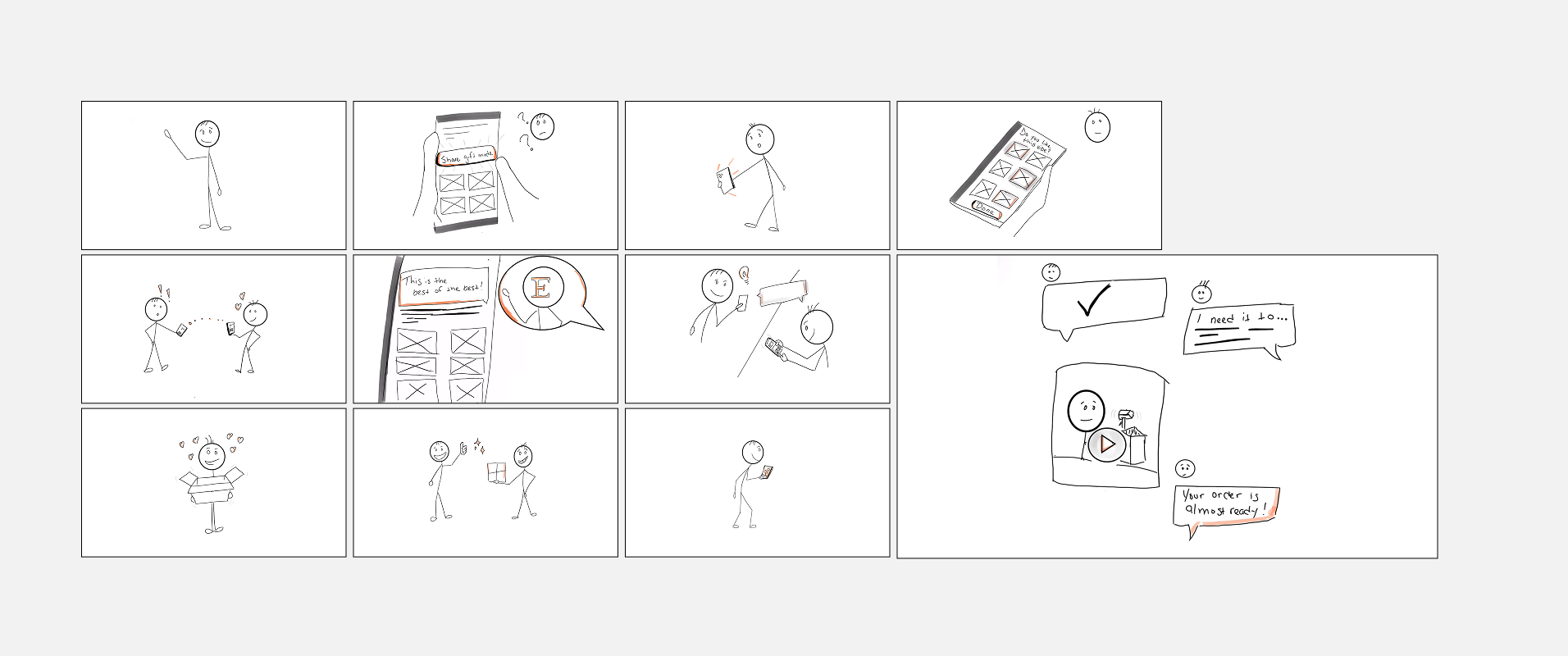
There was also a set of features, collaborative gifting, that we didn't get to fully mock up within the timeline. So I created a storyboard video to show the concept: a quick, scrappy walkthrough showing how multiple people could contribute to a gift together.
Sometimes the right artifact isn't a polished prototype. It's whatever makes the idea legible.
Handoff and setting the team up for success
When this project was presented to the executive team, the reaction was immediate. The CEO went from asking "how do we do this in a few years" to "how do we do this in a few months". Before we'd left the boardroom, a new team was being spun up in real time.
That energy was exciting, but risky. When a vision gets handed off without guardrails teams can default to shipping the easiest features first and the original intent gets lost. So we stayed late and put together a handoff plan.
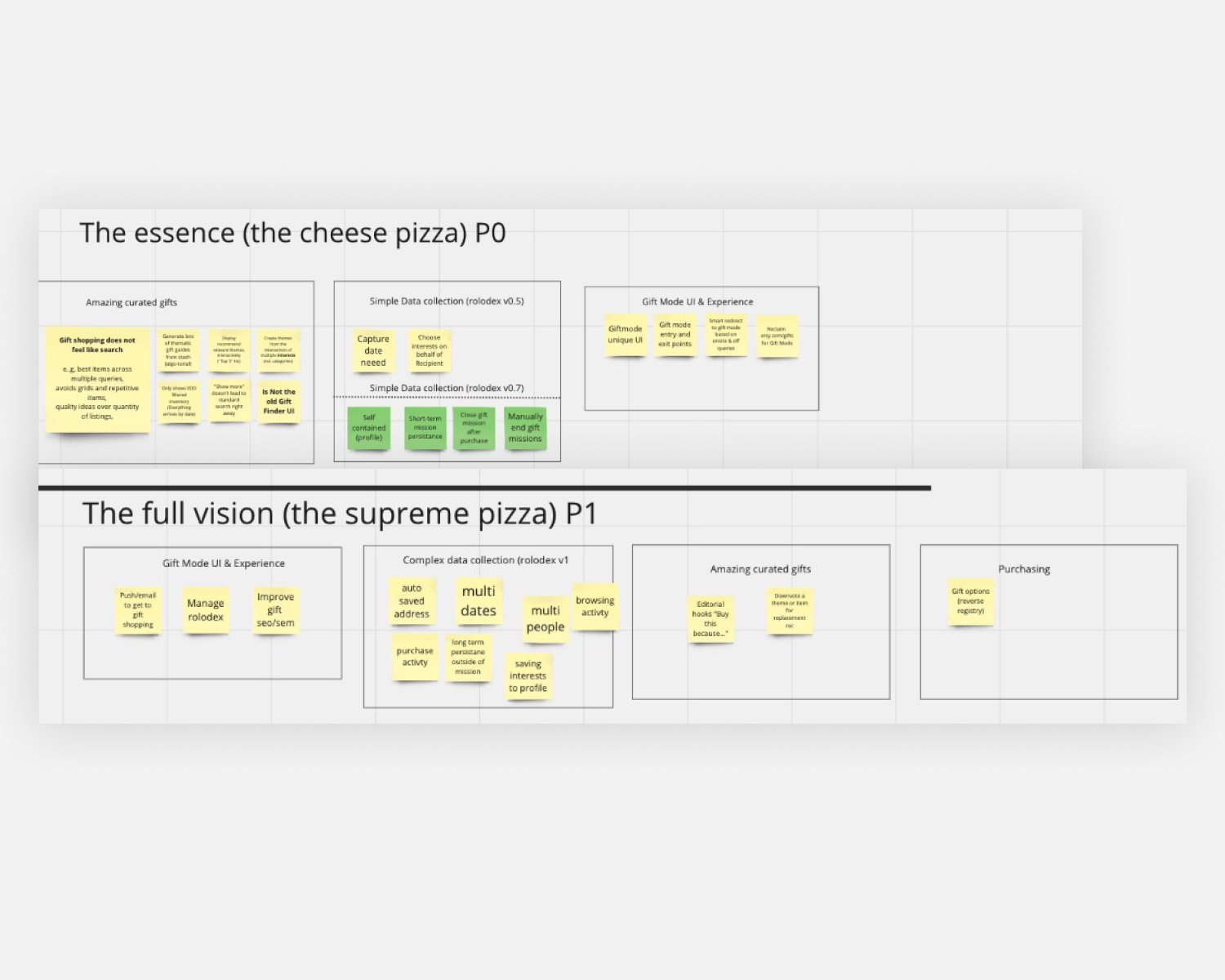
I labelled our framework "the cheese pizza." When you have all the pizza ingredients, grabbing the nearest ones and putting them in a pile doesn't make food. You need to know what's the dough, what's the sauce, what's the cheese, and what's just toppings. For Gift Mode, we called the essentials "The Essence" (P0) and the fuller vision "The Full Vision" (P1). The curated guides and persona-based browsing were dough. Collaborative gifting was toppings: valuable, but not required for launch.
We formulated the plan together as a team, but I took lead in presenting it to the new product leads. The handoff wasn't a document drop, it was a conversation. We wanted them to start with the same conviction we were ending our part with and not just a spec.
- 1M+
- $9M
- 48
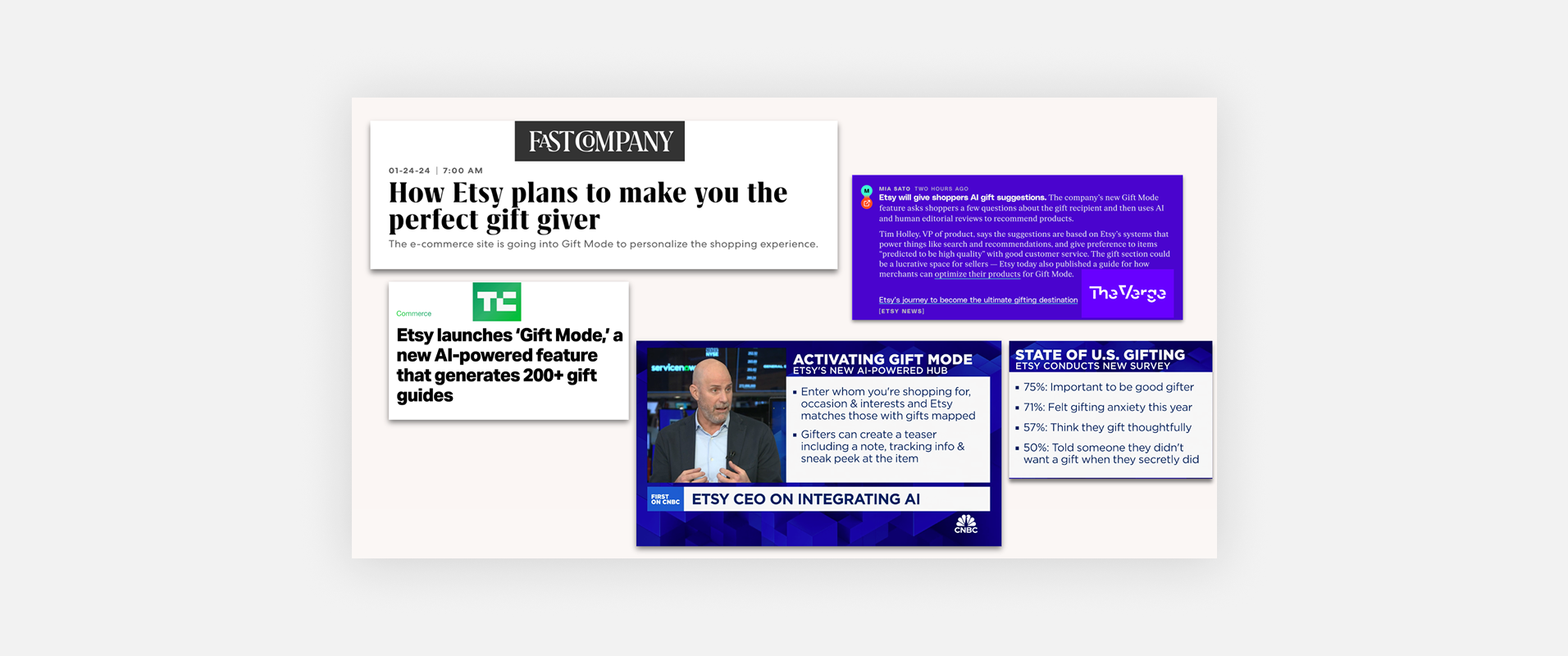
The MVP of the vision we presented in September launched at the Super Bowl in February, and Etsy used the most-watched ad slot, right before the halftime show to tell the world about it. Etsy had never done a Super Bowl ad before. The fact that leadership moved that fast, secured that slot, and built an entire campaign around Gift Mode said a lot about how the work landed.
But the metrics were strong too. Gift Mode drove over 1M visits and $9M in GMS over H1 2024 after it launched. Etsy's unprompted association with gifting hit a record high (+4 points YoY). And when Travis Kelce mentioned Gift Mode and a certain pop star on a podcast, it generated 48 articles, which I find fun.
Internally, the project changed how the company works. A product team assembled and shipped an MVP in a single quarter, a pace I hadn't seen in four years at Etsy. At the office launch party on Super Bowl Sunday, the room was full of dozens who had contributed in some way. And after Gift Mode, other teams started creating their own long-term visions. They were eager to try the model that we piloted.
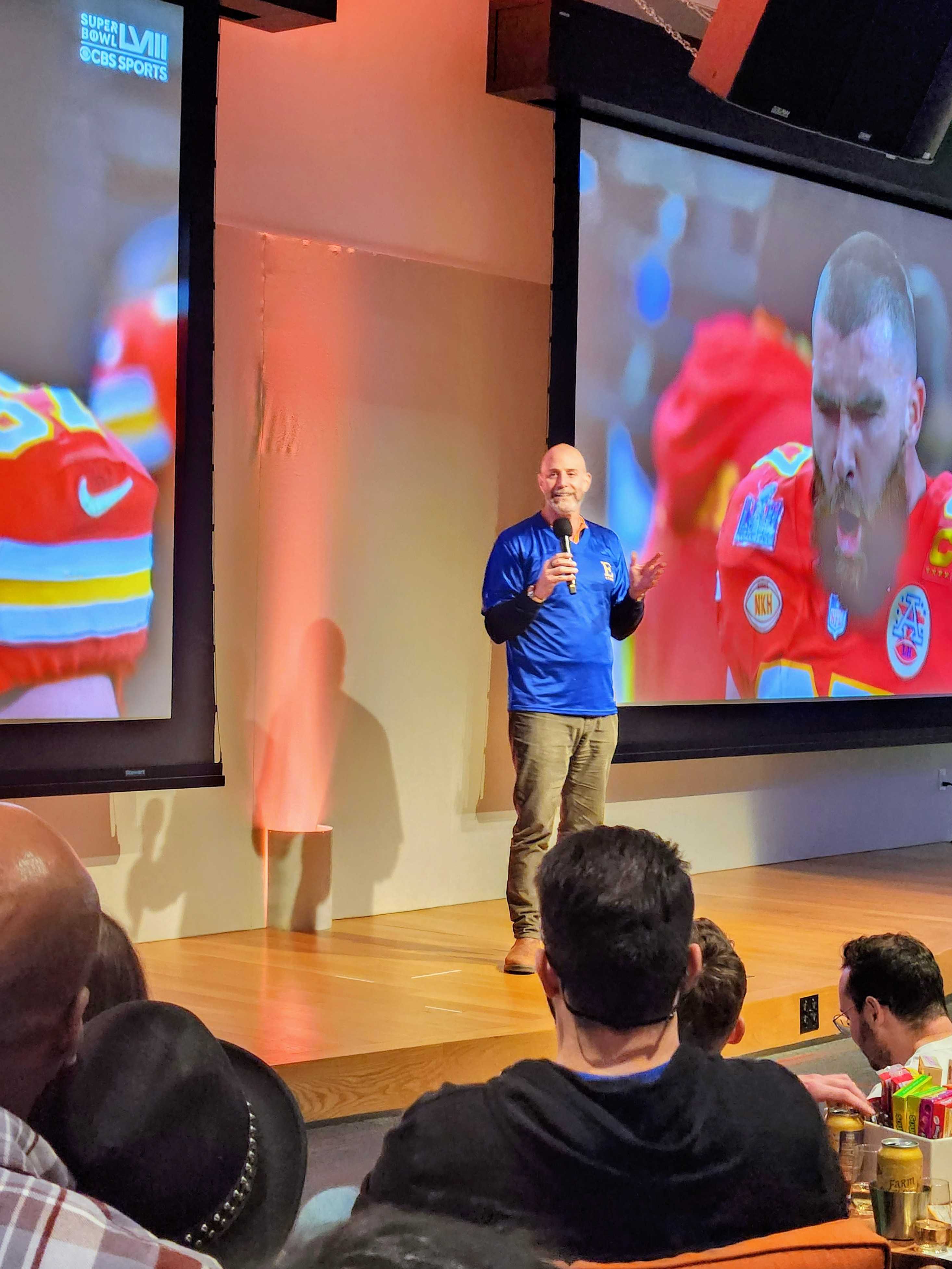
For me, this project was a caraeer highlight, both from the visibility and from the caliber of people that I got to work with. This wasn't our last project as a Future Vision Lab, and we went on to work together very closely for the next year, generating a few more ideas that became seeds for entire initiatives.
I also was reminded to lean into my strengths. Designers often get pulled to act more like engineers or PMs, but Gift Mode reinforced that the best work happens when everyone can balance high and low altitude thinking, focus on what they do best while knowing whento dbble in the rest, and when not to. I learned to rely on my collaborators for what they were excellent at, and to trust my contribution to the vision, the framing, the provocation, and of course the design execution.
I also learned about when to push further than feels comfortable. Before this, like many product designers at large scale companies, I'd internalized a habit of staying close to existing patterns. This project gave me permission to step away from that. Starting loose, then refining, rather than getting bogged down in correctness too early.